White Crust on Pool Tile That Won't Brush Off? What It Actually Is
October 14, 2026
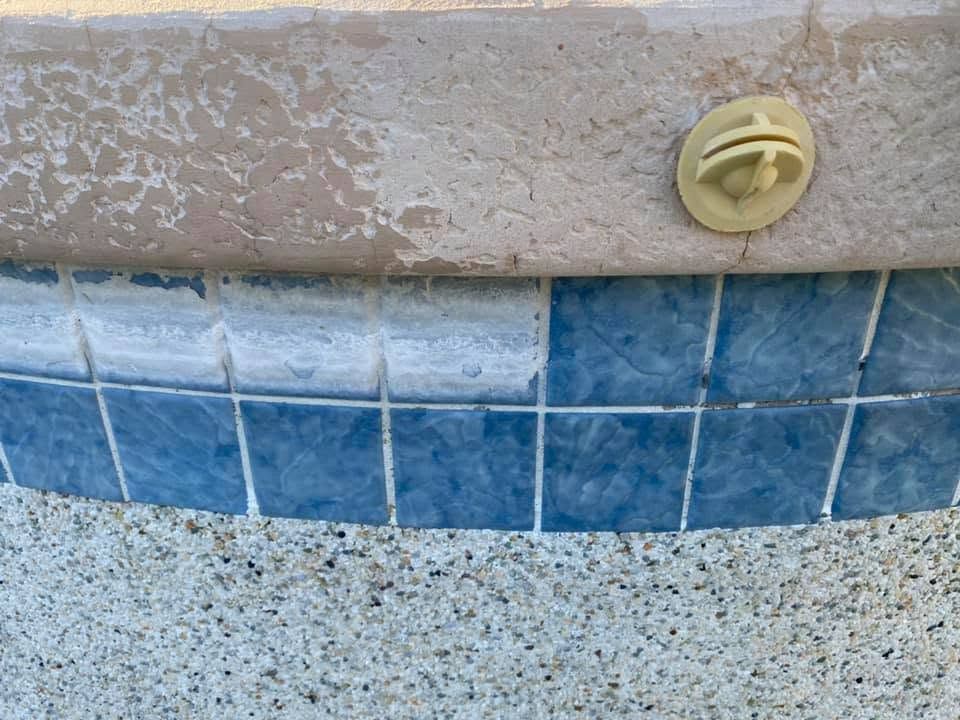
QUICK ANSWER: White crust on pool tile that will not brush off is usually mineral scale left behind when water evaporates at the waterline. The most common type is calcium carbonate, which is white, chalky, and fairly soft. A harder gray or tan version is calcium silicate, which forms slowly and resists almost everything. Sometimes the white film is efflorescence pushing out of the grout from behind the tile, or a residue of pool chemicals and body oils. Telling them apart matters, because the right method for one can damage the surface under another. A professional can identify the deposit, test a small area, and choose a method that clears it without harming the glaze or the grout.
You notice it on a Saturday morning, skimming leaves out of the water. A pale band runs along the tile at the waterline, and when you drag a nail across it, nothing happens. You brush it with the stiffest brush you own. Nothing. You try a little elbow grease with a sponge, and all you get for your trouble is sore shoulders. The band looks like someone drew it with a piece of chalk that refuses to rub off.
If you live in San Tan Valley, Queen Creek, Gilbert, or anywhere else across the East Valley, you are far from alone. That white crust is one of the most common things we see when we walk a backyard, and the first thing we tell homeowners is that the crust is not a single thing. Several different deposits can look nearly identical from the pool deck, and they behave very differently once you try to remove them.
Why the Crust Forms at the Waterline First
Start with how a desert pool loses water. Every day, a pool in Arizona gives up water to the dry air, and the heat of a long summer speeds that up. The water that leaves is nearly pure. The minerals it carried stay behind. Our local water already arrives with a heavy mineral load, so each time the autofill tops the pool off, it adds fresh calcium and other dissolved minerals to what is already there.
The waterline is where this all gets recorded. Water splashes onto the tile, clings, and evaporates in place, leaving a thin film of minerals each time. The next splash adds another layer on top. Over a season, those layers stack into a visible ring. This is why the band is so level and so crisp: it traces the exact height where your water sits most of the time.
Spas, spillways, and raised bond beams show it even faster. Thin sheets of water moving over a surface in the sun can evaporate within seconds, which means a small spill edge can build crust far faster than the main pool wall.
The Four Things That Look Like White Crust
Before anything gets scrubbed, sprayed, or blasted, it helps to know what you are actually looking at. In our experience, white crust on pool tile usually turns out to be one of four things, and sometimes a combination.
Calcium carbonate
This is the classic. It is white or off white, chalky or flaky, and often feels slightly rough, like fine sandpaper. It forms when calcium hardness, pH, and alkalinity combine to push calcium out of the water faster than the water can hold it. Because it is relatively soft and reacts to mild acid, it is the easier of the deposits to remove, though thick buildup can still be stubborn.
Calcium silicate
This one has a different personality. It tends to look gray, tan, or dull white, and it is hard, dense, and sometimes glassy. It forms slowly, often in pools with a long history of high calcium and certain silica sources, and it can show up as a thin film that seems to be part of the tile itself. It does not fizz when it meets acid, it does not scrub off, and it does not respond well to the home remedies that work on carbonate. Many homeowners have spent a weekend on it and walked away convinced their tile was ruined, when in fact they were up against the wrong kind of deposit.
Efflorescence
This is a salt deposit that comes from behind the tile, not from the water in front of it. Moisture moves through the cement based material under and between the tiles, dissolves salts along the way, and leaves them on the surface when it evaporates. It tends to appear at grout lines, along the tile edges, or in streaks that run down from the joints. If you see white wisps growing out of the grout rather than sitting evenly across the tile face, efflorescence is a strong suspect.
Chemical and oil film
Sunscreen, body oils, dried pool chemicals, and fine monsoon dust can all settle into a pale, slightly tacky or hazy layer, especially on shaded or protected tile. This film is often mixed in with mineral scale, which can make the whole band look thicker and harder than it really is.
None of this is meant to turn you into a chemist. The point is that the same white band can have very different causes, and the cause decides the method.
Why It Won't Brush Off
Brushing works on things that sit on top of a surface, like algae, dirt, and loose debris. Mineral scale does not sit on top in the same way. It bonds to the tile glaze as it forms, one microscopic layer at a time, and it gets harder as it cures in the sun and heat. After a few months, the layer has more in common with a thin coat of stone than with dust.
That is the reason a pool brush slides right over it. A brush is softer than the scale, so the scale wins. To remove a deposit, the tool or method has to be harder than the crust and softer than the tile, or it has to dissolve the crust chemically without attacking what is underneath. That narrow window is where the skill is.
TIP: Before you assume the band is permanent, look at it in the early morning or late afternoon with the sun low. Raking light shows whether the crust is a flat film or a raised ridge, and whether any area of the tile still looks glossy underneath. A tile that still shines through a thin film usually has a healthier surface than one that looks dull and pitted everywhere.
What Not to Do With It
Because the crust is so stubborn, the temptation to reach for something aggressive is strong. We have seen the results of most of the usual shortcuts.
Pumice stones and rough scouring pads can scratch glass and glazed tile. The damage often hides while the tile is wet and shows up as a dull, hazy patch after it dries. Wire brushes can scar grout and leave tiny steel particles that rust. Power washers push water into grout joints and can loosen tile edges, and they rarely touch hard scale anyway. Homemade acid mixtures can etch glass, dissolve grout, burn skin, and damage the plaster or pebble finish below the tile when they run down the wall.
WARNING: Acid and abrasive blasting are professional work. Strong acids give off harmful fumes, can burn skin and eyes, and can damage the pool finish, coping, decking, and nearby plants when they run off the tile. Do not mix, apply, or test acid on your own, and do not pressure wash or sandblast tile yourself. If a deposit will not come off with gentle brushing, stop there and have a trained crew look at it.
How a Professional Figures Out What It Is
When we walk a pool, we do not start by blasting. We start by looking, touching, and testing, because the deposit tells us a lot if we pay attention.
We check how thick the crust is and where it is thickest. We look at whether it is even across the tile face or concentrated at the grout. We note the tile type, whether glass, porcelain, ceramic, or a textured stone look tile, because each reacts differently. We note the age of the pool and the age of the tile, and we ask about the water history: how often it gets topped off, whether it has been drained, and what the chemistry has looked like.
Then we test a small, hidden area. A small test patch shows how the deposit and the tile respond before we commit to the whole pool. It is the single most important habit in our work, and it is why we can stop early when something is not going to behave. We would rather leave a little scale behind than haze a glass tile.
The test also tells us which approach fits. Calcium carbonate may release with a gentle approach. Heavy or hardened scale and calcium silicate may need a more patient blast method. Efflorescence may need us to look at where the moisture is coming from before any cleaning will last. Chemical film may clear with a simple, mild cleaning before we ever touch the mineral layer.
Matching the Method to the Surface
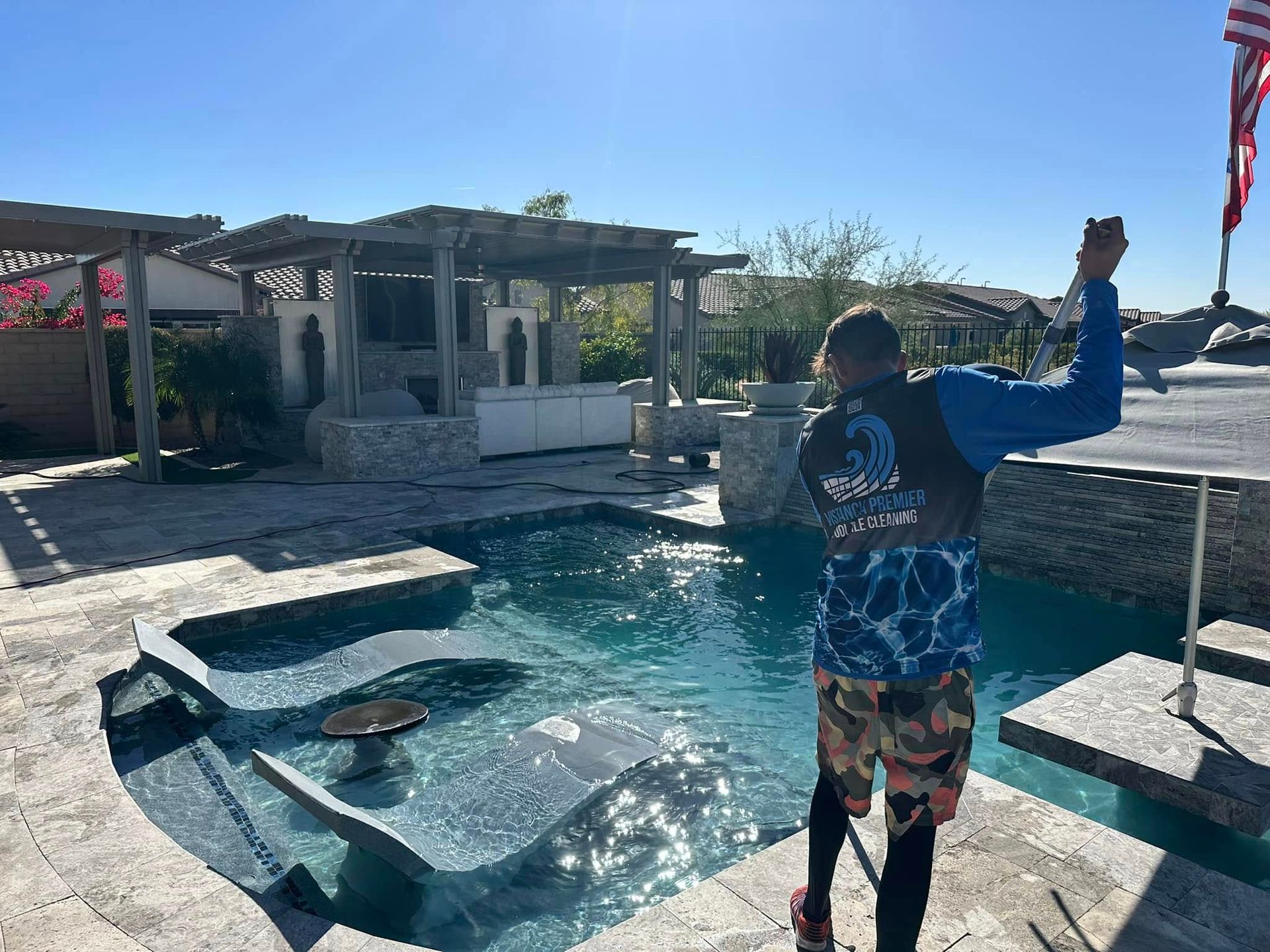
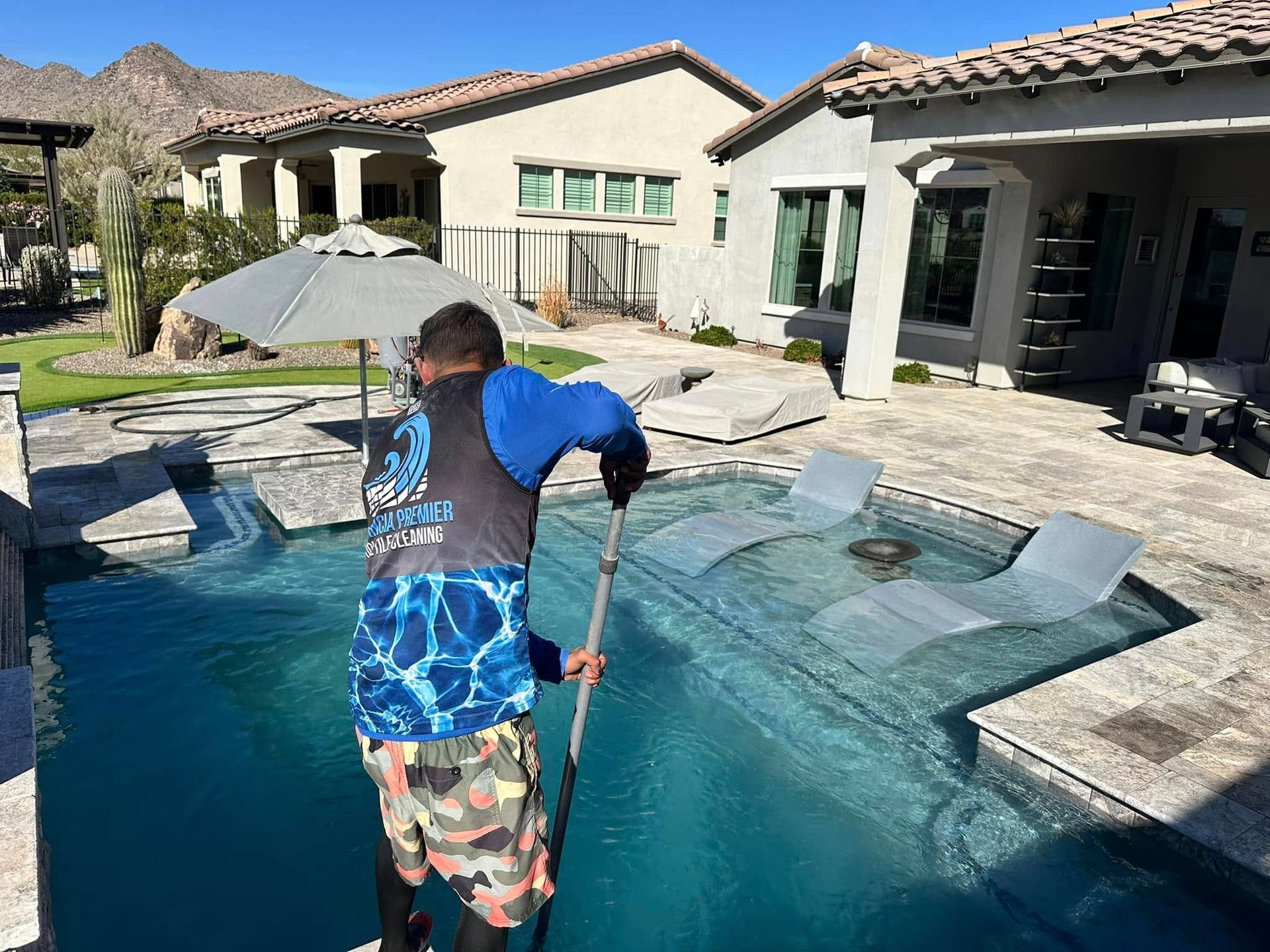
Method matters as much as diagnosis. On our tile work, we use a pH neutral, water soluble blast media called kieserite. It is harder than most scale and softer than tile glaze, so it breaks deposits apart without scratching the face of the tile. Because it dissolves in the pool water, it does not leave grit on the steps or floor, and the pool stays full, so there is no need to drain thousands of gallons for a tile cleaning.
We adjust pressure, nozzle distance, and pace for the surface in front of us. Glass mosaics get lower pressure and slower passes, since glass can haze more easily than ceramic or porcelain. Glossy porcelain gets a different touch than a textured tile. Grout gets care so it is cleaned without being eroded. The same crew that cleans the waterline also works spa edges, spillways, and step trim, so the whole pool looks consistent when we finish.
Pebble finishes, plaster, and natural stone coping are different surfaces with different rules. Acid that is acceptable for one can eat into another. That is a big reason we match each surface to its own method rather than using one approach for everything in the backyard.
The Part Nobody Likes to Hear: It Will Come Back
An honest conversation about white crust has to include this. In a hot, dry desert climate, evaporation never stops, so some mineral will always be left behind. A cleaning resets the tile. It does not change the water. If the chemistry runs high in calcium or pH, or the pool tops off constantly during a long summer, scale returns faster. If the water stays balanced and the tile gets a gentle wipe down regularly, fresh deposits stay thin and soft, and they are far easier to deal with.
Smooth tile helps too. A clean, smooth surface gives scale less to grab, and it gives algae and oils fewer places to hide. Routine brushing starts to work again, because it is fighting a thin new film rather than a rough, hardened one. That is the practical reason to clear a heavy band rather than live with it: it changes how the next season behaves.
A few habits slow the return without any special effort. Keep the water balanced and test it on a regular schedule. Wipe the waterline tile with a soft cloth or soft brush while the film is still new. Watch the autofill, since a pool that tops off every day concentrates minerals faster. Pay attention after monsoon storms, which carry dust that settles on the tile and mixes into the film. And if you ever see the first signs of a new ring, deal with it while it is thin.
When It Is Time to Call Someone
You do not need to rush the day you first see a white ring. Light, new scale is mostly a cosmetic issue, and a gentle wipe may handle it. It is time for a professional look when the crust is thick enough to feel like ridges or nodules, when it has not responded to gentle brushing, when it has a gray or tan cast and a glassy feel, when it is creeping into grout lines, or when it has started to roughen steps and edges where swimmers put their hands and feet.
A good crew will tell you what the deposit is, show you a test patch, explain the method, and be honest if a gentler approach is the better call. It should not be a hard sell or a guess.
Frequently Asked Questions
What is the white crust on my pool tile?
Most often it is calcium carbonate left by evaporation at the waterline. It can also be calcium silicate, grout efflorescence, or an oil film. A test patch tells them apart.
Why won’t the white crust brush off?
Mineral scale bonds to the tile glaze and hardens in the heat. A brush is softer than the deposit, so removal needs a method harder than scale but gentler than tile.
What is the difference between calcium carbonate and calcium silicate?
Calcium carbonate is white, chalky, and fairly soft. Calcium silicate is harder, often gray or tan, forms slowly, and resists gentle methods, so each needs a different approach.
Is white buildup on pool tile always calcium?
No. It can also be efflorescence rising through the grout or residue from sunscreen, oils, dust, and dried chemicals. Many pools have a mix, so testing a small area helps.
Can I clean calcium off pool tile myself?
Light, new film often yields to gentle wiping. Thick or hardened scale calls for professionals, since acid or blasting done wrong can haze glass, damage grout, or harm the finish.
Does cleaning the tile require draining the pool?
Not with our method. Soluble blast media works while the pool stays full and dissolves into the water. Draining is a separate service for other surfaces.
Will the crust come back after cleaning?
Some mineral always returns in hot, dry weather because evaporation never stops. Balanced water, regular light wiping, and watching the autofill keep new deposits thin and manageable.
Can hard Arizona water cause this?
Yes. Local water carries heavy minerals, and evaporation concentrates them. Each top off adds more, so East Valley pools often show visible scale within a single season.
Reading the Crust Before Choosing a Cleaning
White crust on pool tile is rarely one single thing. Calcium carbonate, calcium silicate, efflorescence from the grout, and a film of oils and dust can all look alike from the deck. Because each one responds differently, scrubbing or spraying without knowing the cause risks hazing glass or etching grout. A close look in low light and a small test patch reveal what the deposit really is. Balanced water and gentle wiping then keep new scale thin.
Since opening 22
years ago, Vistancia Pool Tile Cleaning
has tested and
cleaned waterlines
across Queen Creek, Arizona, where hard water and dry heat leave minerals behind every day. Matching a soluble, tile safe method to each surface clears stubborn bands without draining the pool or scratching the glaze. With the tile smooth again, brushing works the way it should, and the waterline stays bright through the long summer months, season after season.